

Inventing Your Own Exercises with Design Thinking
Creativity in the Practice Room!

This week has a TL/DR. Read on for the thought process and invitation to make your own exercises…
A best practice for learning: separate technical development from repertoire practice. But where to find technical development exercises that most directly help us learn our repertoire?
Some ideas:
From the Void
You could invent exercises ex nihilo. Remember: constraints are vital traits of creativity.
The Law and Order Method
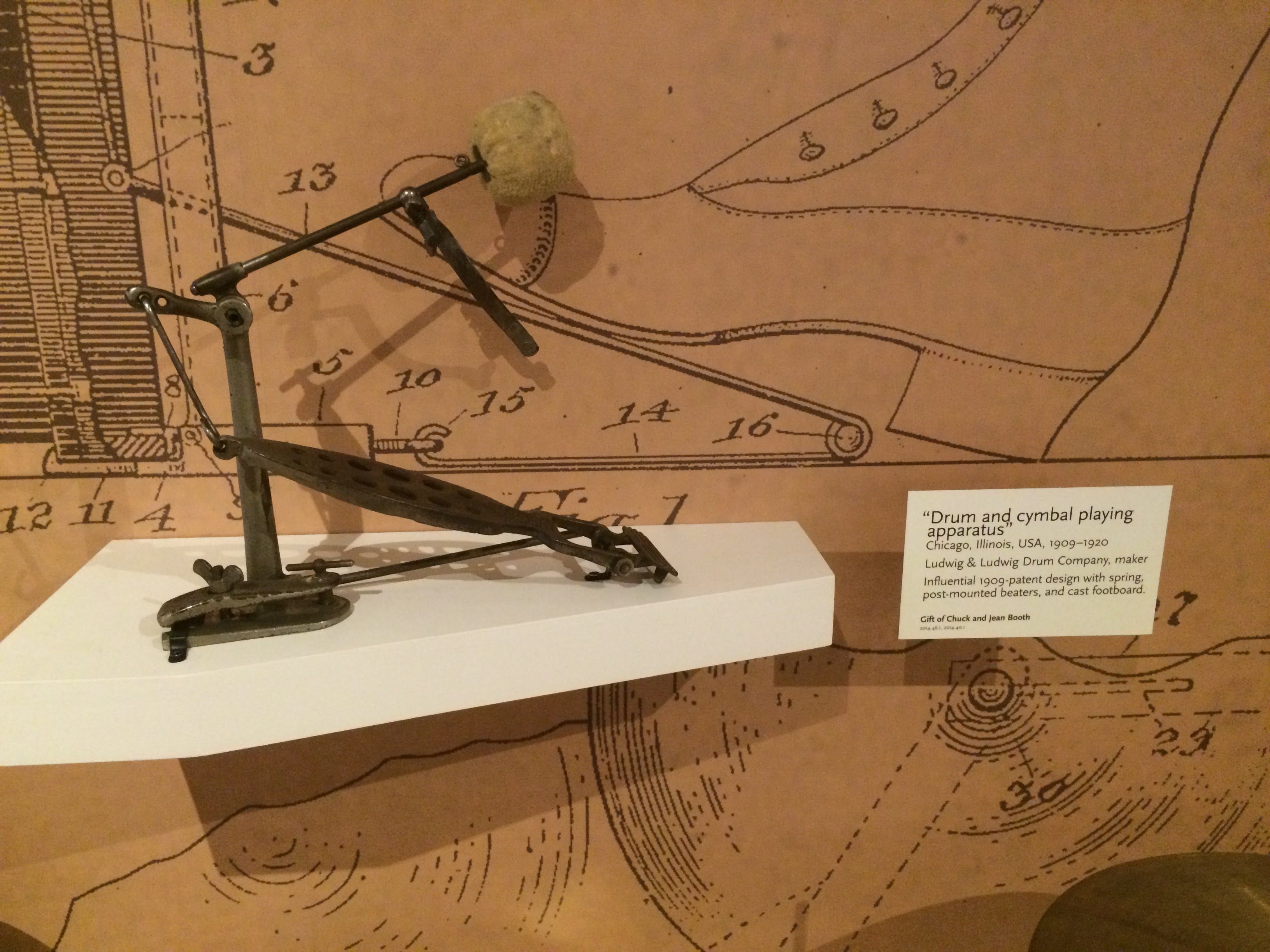
I love watching Law and Order because the cases are “ripped from the headlines,” relevant to our current events. Likewise, the best exercises are taken from your current repertoire. Maybe they are exact quotations—there’s nothing wrong with repeating a troublesome measure over and over—or maybe they are inspired by them, with names, faces, tempi, and other technical challenges changed to protect the innocent

.
Variation of Existing Exercises
Vary or change an existing technical exercise, from any of the myriad sources across myriad genres and myriad instruments available to us (such as this book). This technique is the easiest and most significant available to those who identify solely as performers.
The Librarian: By the Book

Play an existing exercise as written. Over time, the player develops a vast library of exercises that can be deployed to fit a number of challenges. I spent much time creating a packet of exercises from a number of famous sources organized by technique, and offer some of my favorite resources at the end of this book. This home-grown packet is tremendously valuable in lessons, where a student might respond more effectively to Wilcoxen’s method of addressing finger strokes than to Delécluse’s exercises. To be useful to a serious practitioner, the exercises chosen should mirror as closely as possible the technique or repertoire being studied. Thus, an adroit percussionist should have a large library of material available to them. If you’re not going to tailor-make a suit for each customer, you should have a lot of suits in stock.
Let’s zoom in on the Law and Order Method, as it allows us to tailor-make exercises most effectively. The piece: Scheherezade. The method: Design Thinking
How To Invent Your Own Exercises with Design Thinking
Design Thinking is a workflow that emphasizes human-centered and responsive design. While generally used for creating products, it works well for musicians as a companion to Deliberate Practice:1
Identify problem/Empathize with Problem
Prototype solution
Get Feedback
Iterate Revisions
Implement Product
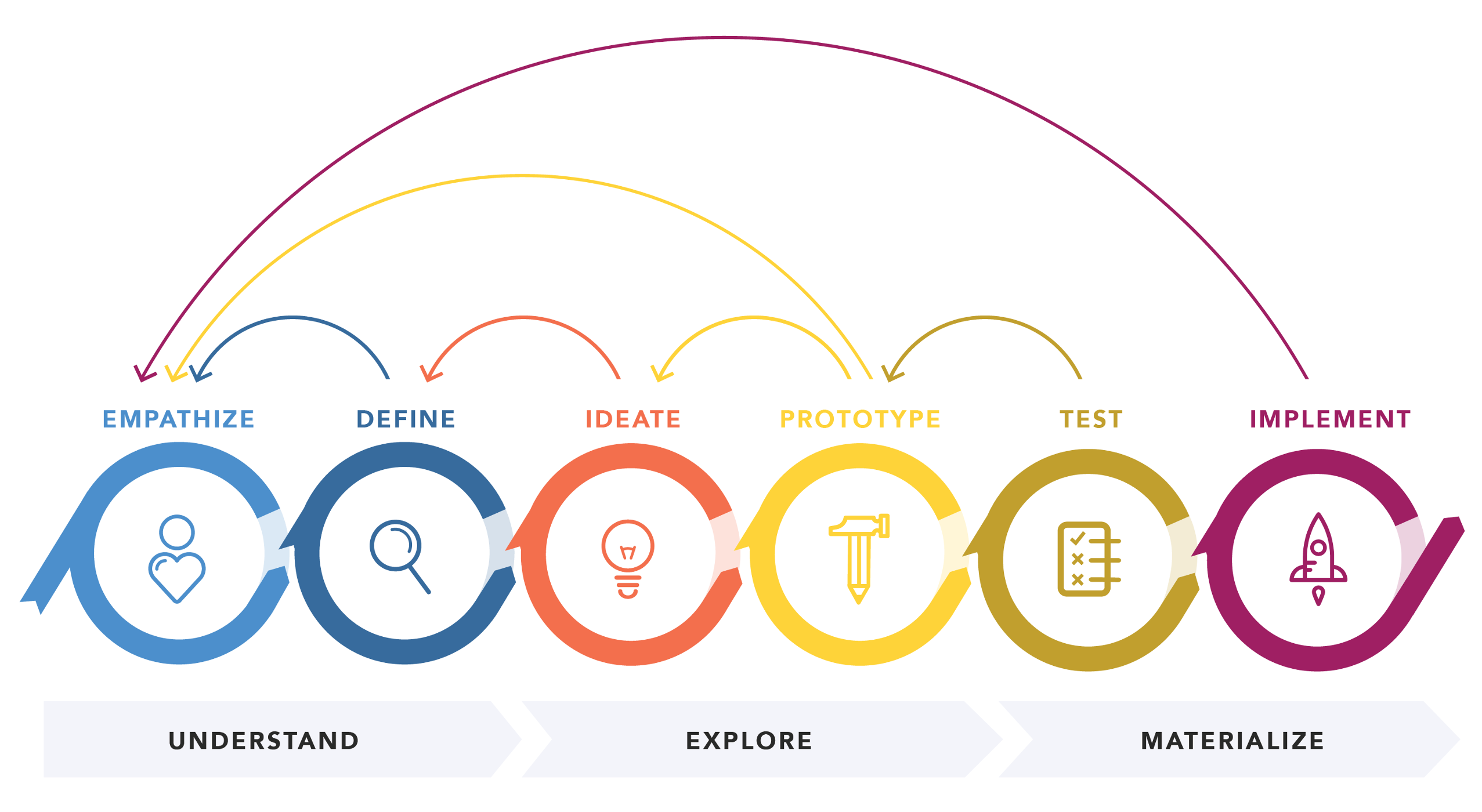
To apply the design thinking process to music practice, we need to make a few adjustments:
Incubation as implementation time: after settling on a “solution,” musicians need time to build in physical development so that their muscles learn how to do the new idea. This practice should be Deliberate Practice, where the player is focused intently on the task at hand, enacting a loop of receiving feedback, intuiting solutions, and assessing whether the solution worked.
Creativity: creativity engenders autonomy and authority over one’s progress, which inspires more effective mental representations. A sense of play indelibly improves the entire experience.
Reflection: musicians can benefit from metacognitive work around why what worked worked.
So, our Design Thinking-inspired process will look like this:
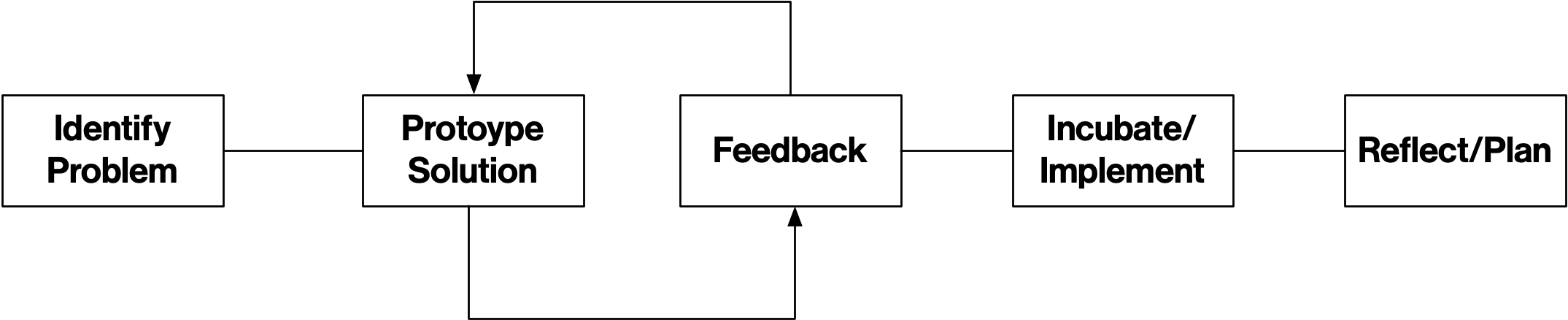
Let’s go step by step with Scheherezade
1. Identify Problem
Isolate a technique or musical passage that is currently vexing you.
The third movement of Rimsky-Korsakov’s Scheherezade includes a famously difficult, neurosis-inspiring snare drum part. It’s two measures of snare drum solo before the REAL soloist, the clarinet, enters.
Here’s the snare drum part as written:
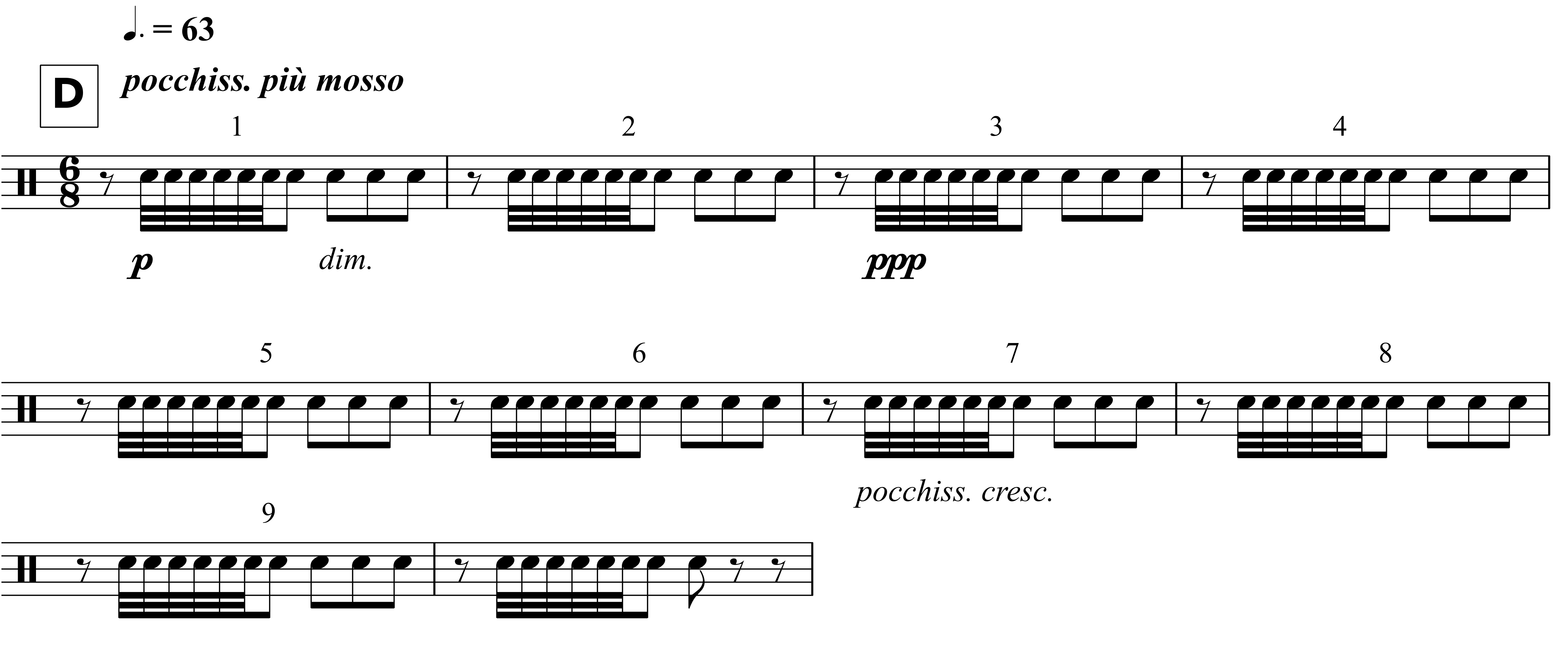
Articulate why the passage is difficult. Extract its musical DNA to find fundamental techniques, and be specific.
Here are my thoughts about the Rimsky-Korsakov:
Rhythmic clarity. I double-stroke this passage (sorry, German percussionists!), and making sure the 32nd notes come out cleanly is essential.
Dynamic control at ppp
Phrasing: the phrase should have a lilting inflection.
Note that I didn’t say tempo. Let’s explore the passage without changing the tempo (dotted quarter = 63)
2. Prototype solution using invention and variation
Below are some solutions I might prototype to decrease the challenge in the passage
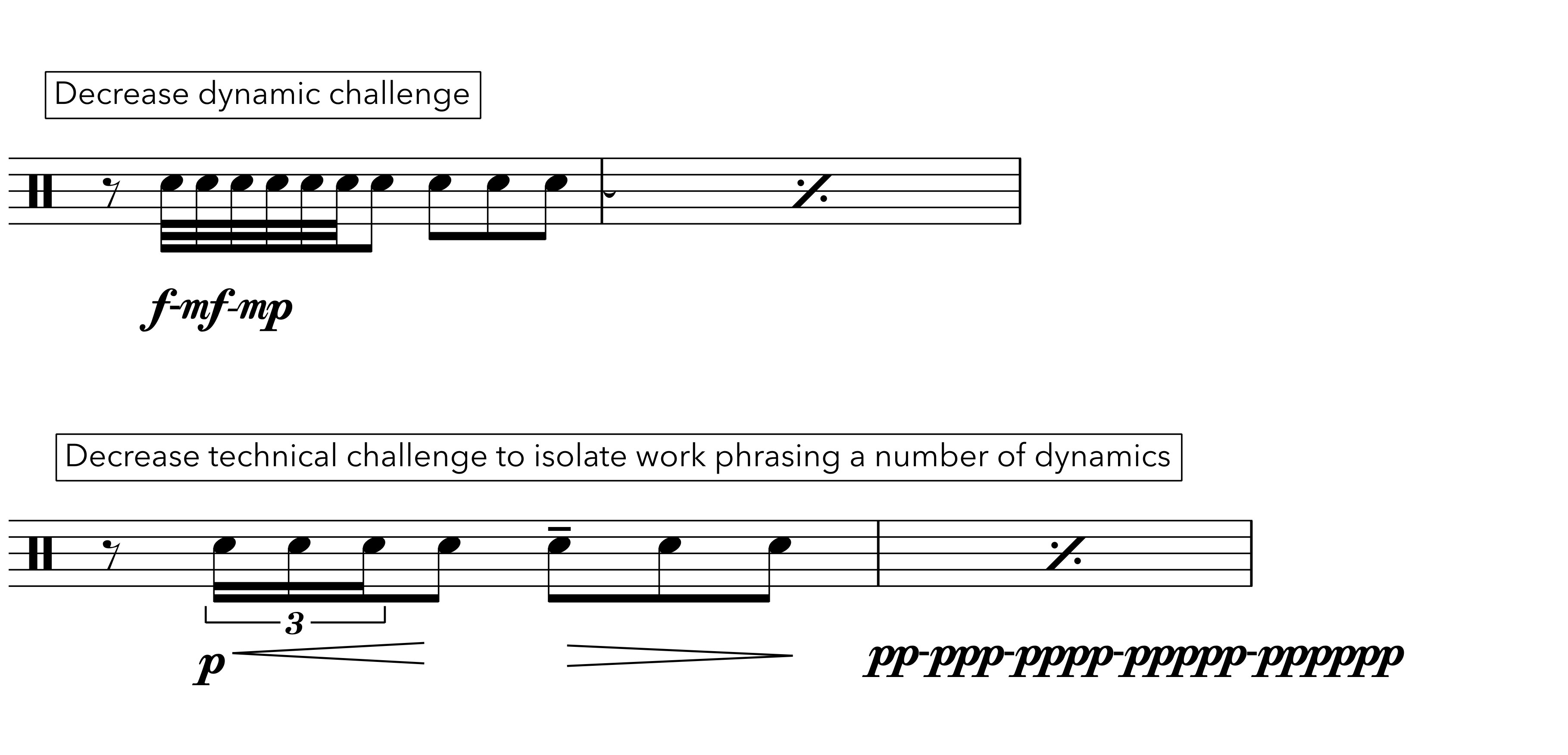
In the first example, playing the passage at a louder dynamic allows for a singular focus on rhythmic clarity and inflection. In the second, reducing the 32nd notes to 16th notes (what might be called playing the “skeleton” of a rhythm), allows for nuanced phrasing at the desired dynamic and beyond!)
Now, let’s increase the technical challenge:
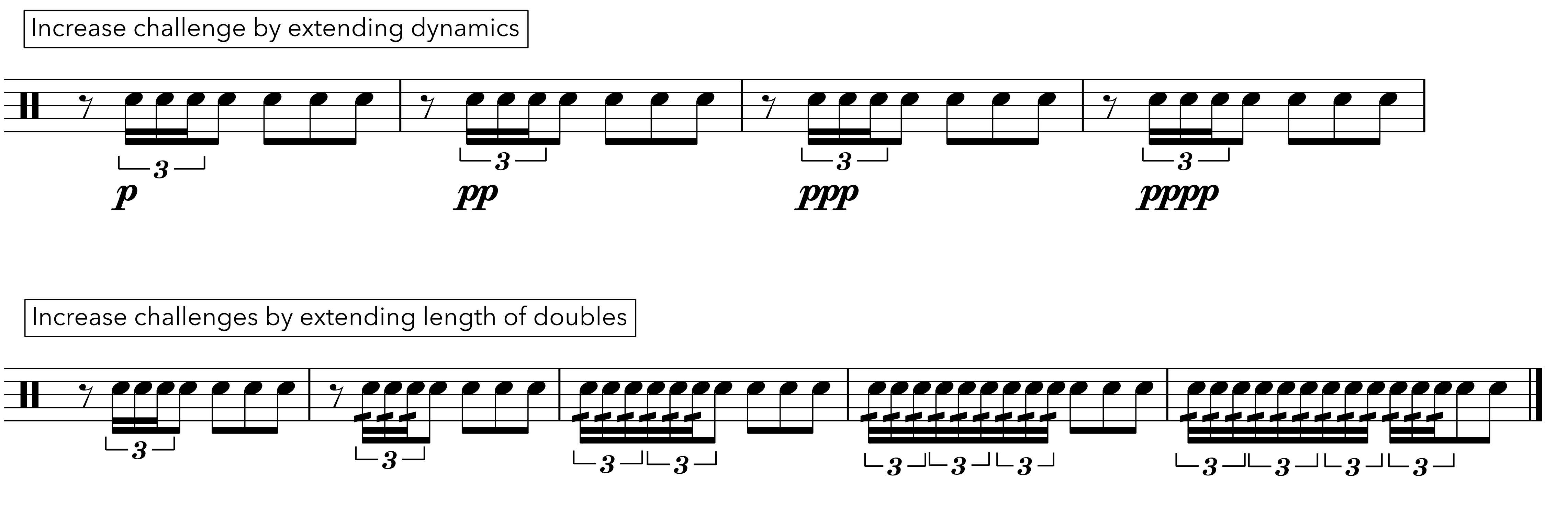
In the first example, the difficulty is increased by increasing the softness of the passage. In the second, the doubles are extended over a longer period of time—tricky!
Finally, one might create a stand-alone etude based upon these difficulties, the playing of which would (presumably) help one surmount them:

Are these variations worth publishing? No.
Do they do the job? Yes!
Does the sense of ownership that comes from inventing something inspire deeper practice? Yes!
Did the process of creating variations help us discover some effective ways of playing the passage that might then apply to other passages in the future? Definitely
Did the exercises help facilitate playing without performance anxiety by preparing us for surprises on stage? Yes!
3. Get feedback on your solution
For each of the above variations, get feedback as soon as possible. Return from the variation/exercise to the passage as written to check your work against your mental model.
If the exercise/invention generates improvements, repeat the change enough to solidify the change
If the result does not work as intended, try another change, using what they learned from the failure to improve their hypothesis of might work
4. Incubate/Refine
Experts say one should try something for at least 7 minutes before the muscles are acclimated. Once you’ve decided that your invention is working, keep going: don’t declare victory or defeat yet!
5. Reflect/Plan
Reflection is the secret skill of musical experts. Ask yourself some metacognitive questions to set the stage for a productive next practice session. Examples include:
What worked during this practice session? What didn’t?
What methods should I try on this passage again in the future?
Of what I tried, what techniques might be successful in future practice sessions?
Happy Practicing!
For a succinct (and positive!) introduction to the principles of design thinking, I recommend Bill Burnett and Dave Evans, Designing Your Life: How to Build a Well-Lived, Joyful Life (Alfred A. Knopf, 2018).