

7 Tips for Creative Practice
Part I

Practicing is essential to everything we do as musicians. But often, our practice sessions are repetitive and dull, with too much focus on our muscles and too little attention paid to our ears and minds. Here are 7 ideas to enliven your practice with an eye towards creativity, proactivity, and active engagement with your musical development. And, they’re backed by scientific research about how we learn.
This week I’ll elaborate on 4 of them, and next week on 3 more.
7 Tips for Creative Practicing
Take on Big Problems
Experiment on Yourself
Turn Your Music into Exercises
Turn Your Exercises into Music
Practice Multi-Modally
Record Yourself for Instant Feedback.
Be Curious
1. Take on Big Problems
Articulate larger issues in your playing that you’d like to address. Then, develop a practice routine that addresses those issues incrementally. While most of us are great at setting short-term goals, taking on a Big Problem helps give each practice session a purpose as part of a larger goal, and allows you to see your progress more effectively. It also provides a neat shorthand for practice goals within each session.
Your theme could be tone production, timing, maintaining expressivity in high-pressure situations, or keeping your hammers low. As you work to hear your sound in a more nuanced manner, you’ll get better at hearing your sound, which will improve over time the quality of your mental representation—your sense of how something should sound, look, or feel. Over time, your themes will shift from fundamentals of tone production and timing to phrasing ideas and inflection and character and (fingers crossed) style.
As an example, I wrote a bit about developing a technical development plan here:
Why is this practice of planning creative?
Knowing where you are in the learning process frees your mind within the practice room to mess around with your material, try out new ideas, and fail without worrying about jeopardizing a larger project. This freedom puts you in dialogue with your ideas, a key element shared by creative thinkers.
Deciding to focus your work around a larger issue helps jumpstart a feedback loop of deliberate practice by giving you a feeling of both authority (enhanced expectations) and autonomy (a sense of ownership) over your learning, qualities that Gabriele Wulf and Rebecca Lewthwaite articulate as being central to motor learning in their “Optimizing Performance Through Intrinsic Motivation and Attention for Learning” (Wulf & Lewthwaite, 2016).
2. Experiment on Yourself
While my favorite musical memories are those moments where creativity took over and I lost track of time, it’s important to be diligent in your practice to allow for creativity to take hold. But, with limited practice time each day, how might one plan their work to create the space for that freedom within the practice room? By creatively (and aggressively) experimenting on yourself, and keeping track of the results.
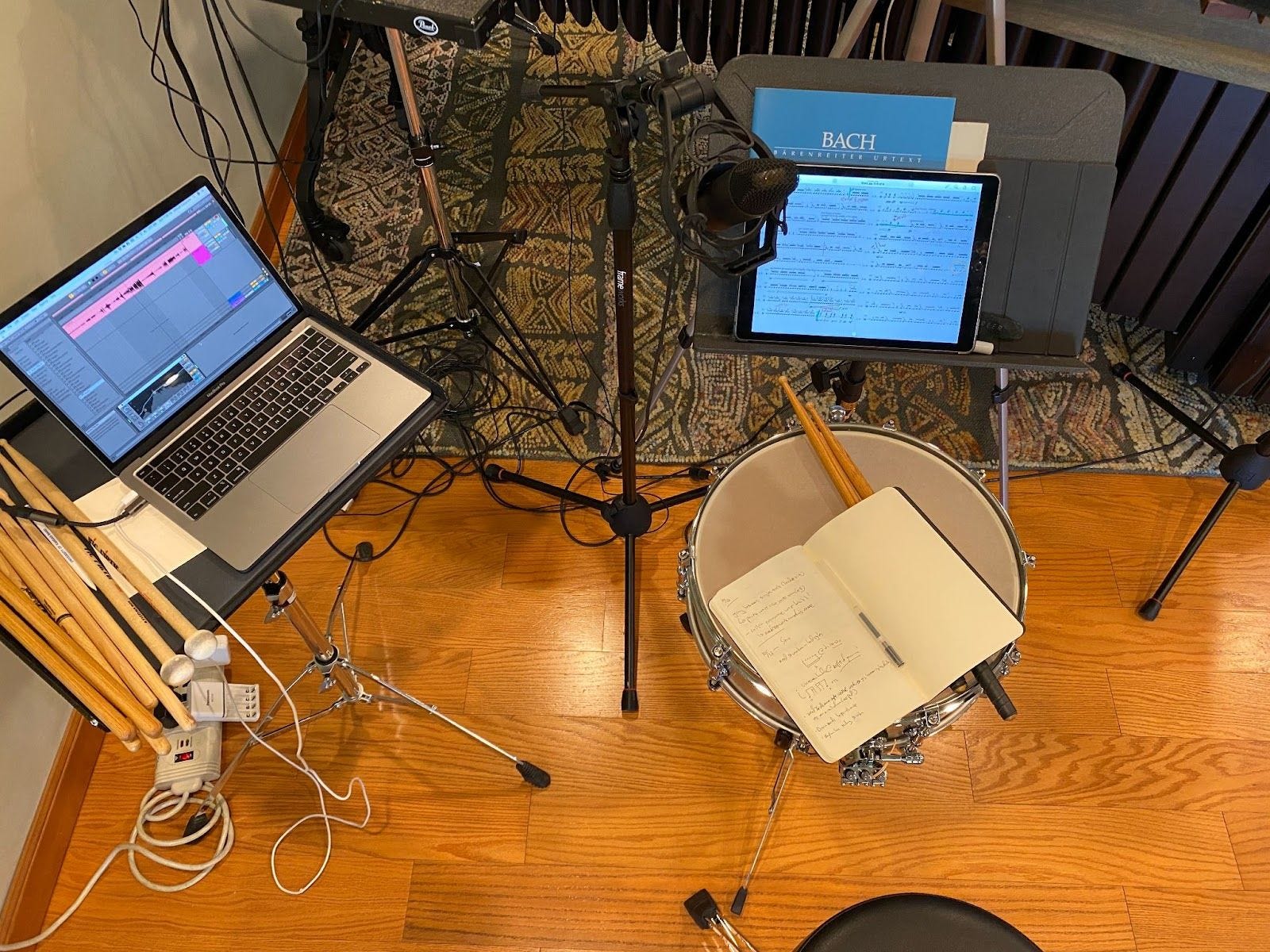
Design Thinking and Timers
I use a modified version of Design Thinking in my practice. As I mentioned last week, Design Thinking is a workflow that emphasizes human-centered and responsive design. In addition to its utility in refining and learning musical material, Design Thinking is valuable for helping musicians learn how long a task might take to complete.
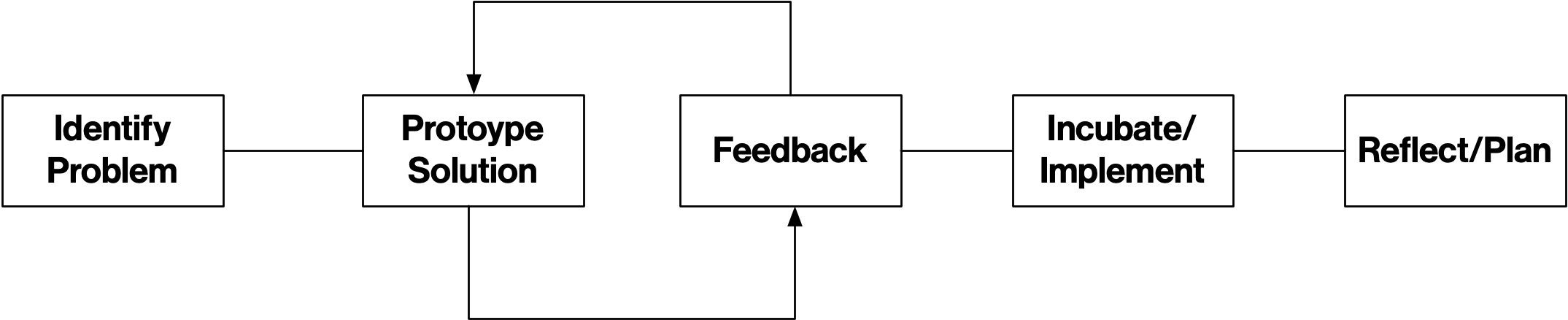
Unfortunately, endlessly prototyping solutions and getting feedback might make you late for some appointments. To keep myself on track, I employ a a modified version of Pomodoro Technique in my practice. Developed by Francesco Cirillo, the Pomodoro Technique is designed to facilitate planning, tracking, recording, processing and visualizing. Even though the Pomodoro Technique has been rebuffed by motor learning experts, I still use its tenets as a way of making sure I stay on track.
Here’s how it works:
Make a to-do list for your practice session. This could be as broad as “warm up, work on Psappha (highly recommended), do recital run-through” or as specific as “work on double strokes for use within snare drum etude, work on snapping fingers, try and memorize a section of text, work fluidity of line in F-L in Piece Y, review notes in Piece Z.”
Set an intention for a single chunk of time. “warm up” or “learn these notes” are good intentions. “Learn Khan Variations” is not a good intention.
Prototype your intention: work on your task for 25 minutes without deviating, using all diagnostic tools and musical solutions at your disposal. Avoid distractions and being sucked into another task or any Slow TV. Remember, the timer is running!
Get feedback on your solution: after 25 minutes, review the work you’ve completed. If the task was not completed, repeat, filing away the information on timing for use another time.
Repeat!
After 4 blocks of 25 minutes, take a longer break, maybe eat an actual tomato.
I structure my practice routine around a few Pomodori of warming up, a few learning new material, and some focused on review and reflection. After a few sessions, I learn how long a task will take, allowing me to more effectively plot out my future practice sessions.
Here’s an example of how I structure my practice sessions. Each section could be 1-4 25-minute sessions of time.
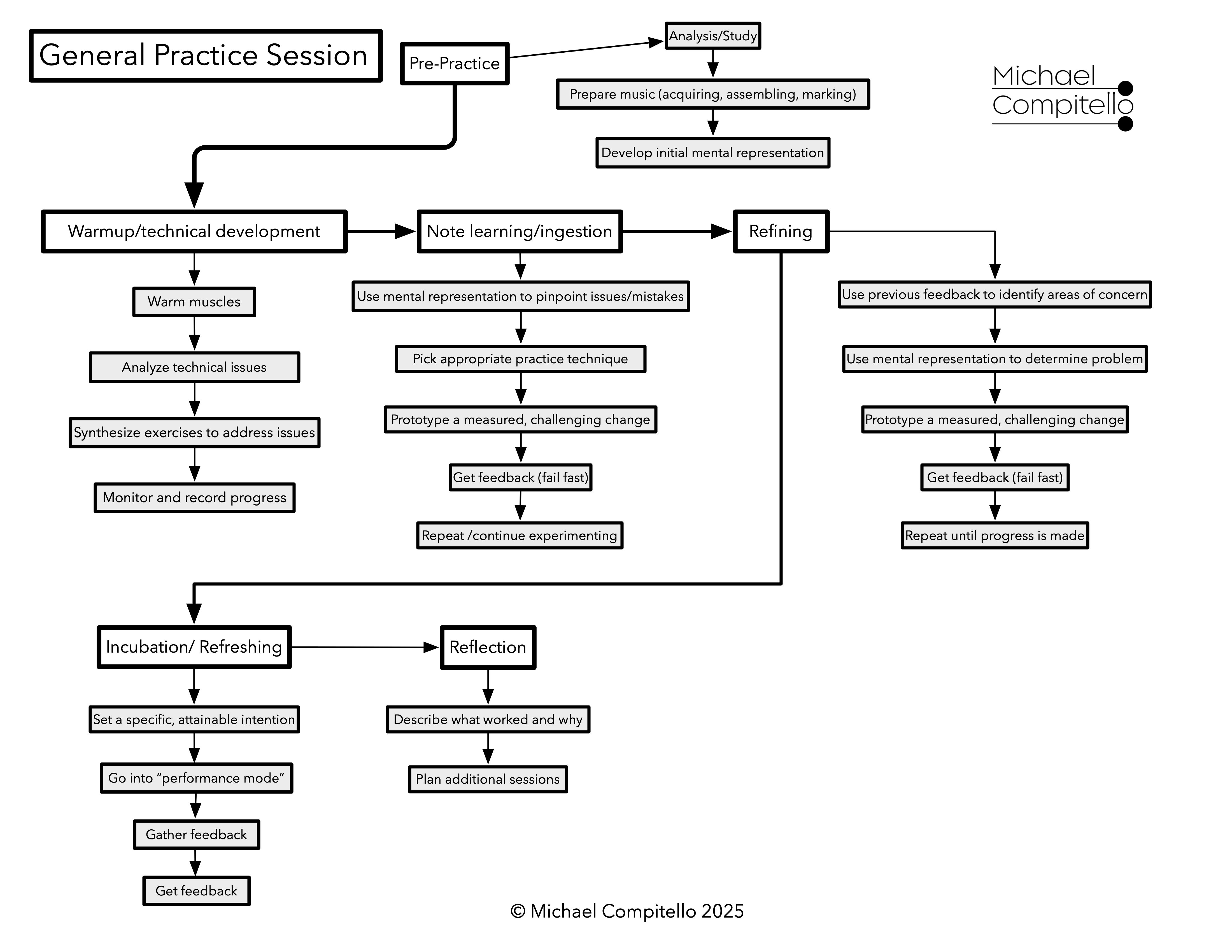
Think of each Pomodoro as a mini-experiment—a design thinking loop—where you explore a specific problem and track your effort and results. The frequent breaks give you some time to journal your results, and provide a mental break between sessions of challenging work. Changing what you work on each 25 minutes also creates some “contextual interference,” the motor learning phenomenon where frequently changing the context of a motor skill rather than maximizing repetition can facilitate learning.
By minimizing distraction and foregrounding a single task, the technique has allowed me to increase the amount of time I spent in flow, that wondrous state eliding ease and accomplishment. (Be sure to have a notepad nearby, as many of us have great inspirations while in flow). At the same time, this technique has increased my focus, as each Pomodoro is in essence an exercise in concentration.
Dear Diary
Critical to our work in the practice room is what happens AFTER our work in the practice room. And there’s very little more creative than reflection.
Journaling your practice helps you both keep track of what you’re doing and analyze what you have done to see what you should do in the future. Reflection is a key part of “recombination,” an essential part of making sure what we learn stays learned. As Lynn Helding puts it in *The Musician’s Mind, “*Learning is the process whereby we hold about seven bits, or four chunks, of information in mind, manipulate those bits or chunks, and recombine them with facts or experiences we already know.” Journaling and reflection are key elements in that process.
What should your journal look like? It depends on the person. Some will track every minute of their practice, while others will paint in broad strokes. Some will write a paragraph about their struggles with a technical issue, and others will be as terse as Magic 8 Ball. Both work: the important thing is not the journaling, but the reflection it leads to.
For more about this, take a look at my “How to Learn Anything Online.”
3. Turn Your Music into Exercises
Creativity in the practice room is the best way to achieve peak performance in classical music.
So many of the best practices for encoding new information and recalling it under pressure depend on recombination, variation, flexibility, and (dare I say it?), creativity. Not all performers are writing sonatas or concerti grosso. But we are varying our material in the practice room, changing our music to help us learn it better, perform it better, and advocate for it more effectively.
Instead of repeating challenging passages over and over, I like to make a “most wanted list” in the repertoire I’m practicing: a collection of challenging passages that I dissect and turn into warm-ups and exercises in technical and musical development. Actively creating material weakens performance anxiety by helping you find many ways of executing a passage, lessening the chances you might be surprised on stage.
I covered this last week:
4. Turn Your Exercises into Music
Take an active hand in your technical studies to make them more musical, mentally engaging, and flexible. Focus on active change informed by critical listening rather than repetition. Dynamically altering your exercises reduces the risk of injury and develops a broader interpretive palette. It is also key to developing myelin, the neural sheathing essential to learning new skills. Most importantly, this tinkering is essential to developing mental representations on your instrument: it sets the bounds of how your instrument can sound, what it looks and feels like when it does, and helps you link physical motion and sonic change.
Challenge yourself to try your exercises with a different musical character, or in the style of your favorite performer. Try a new approach you haven’t explored yet. Taking on a proactive mindset—“let me try this” or “I want my audience to hear this character”—rather than a reactive, defensive attitude (“yikes, I missed that note” or “I hope I don’t overshoot that octave”) can reduce performance anxiety and minimize distraction by subsuming your technique within a larger, altruistic musical goal.
🚨 Example
You might be creative in grouping your exercises by MOTION and not NOTATION.
What do the Flam Accent and Single Paradiddle have in common?
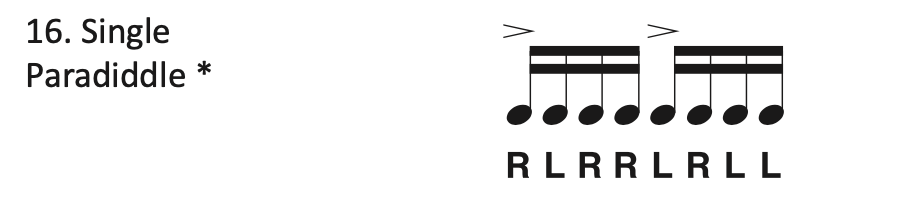
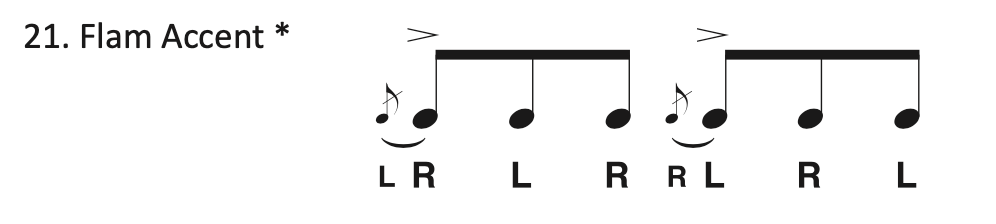
They’re the same motion!

A little bit of practicing going between the two can help you develop fine control of your grace notes and rebounds, reducing physical tension as you focus on larger muscle groups.
That’s all for now. Next time, I’ll take on 5, 6, and 7 on my list.
Happy Practicing!